
The Mental Health Continuum
for Healthcare Workers and Caregivers
This article introduces the Mental Health Continuum Model and how it can support healthcare workers and caregivers. It explains how mental health can change over time, how to notice early signs of stress, and what actions people can take to care for themselves and each other. The goal is to provide a simple, practical tool that can be used in everyday work.
Healthcare and caregiving work is both deeply meaningful and demanding. People who provide care in places like hospitals, community care, long-term care, home support, and other health services often work in fast-paced, high-pressure environments. Their jobs require emotional effort, responsibility, and compassion every day. While workers in this field are skilled and resilient, the realities of long shifts, staff shortages, complex patient needs, and ongoing systemic pressures can slowly affect their mental, emotional, and physical health.
Across healthcare settings, many caregivers carry an ‘invisible load’. This means they support patients and families through stressful situations, uncertainty, and loss, while also managing their own stress, fatigue and personal responsibilities. There is often pressure to ‘push through,’ put others first, and keep going, even when energy is low and support is limited. Over time, this can lead to feeling overwhelmed, burned out, emotionally drained, or disconnected.
Thriving in healthcare does not mean being unaffected by challenges. Instead, it means working in an environment where people feel supported, aware, and able to check in on themselves and others.
The Mental Health Continuum Model1 offers a simple and practical way to do this. It shows that mental health can change over time, helps people notice early signs of stress, and gives a shared language to talk about when support may be needed.
- Mental Health Commission of Canada: Caregiver Resources
- Canadian Medical Association: Wellness Hub
- Centre for Addiction and Mental Health (CAMH): Learning Resources
The Mental Health Continuum Model
This model helps us understand that mental health is not fixed. It exists on a spectrum, meaning it can shift depending on life and work experiences.
By recognizing where we are, and where our colleagues might be along this spectrum, we can notice problems and take actions sooner. It is also important to remember that everyone’s limits are different. What feels manageable for one person may feel overwhelming for another. Thinking about mental health this way reduce stigma and create an environment where people do not feel like they have to suffer in silence just to keep doing their job.
For healthcare workers, mental health can be affected by:
- High responsibility
- Complex decision-making
- Emotional demands
- limited time to rest and recover
The continuum encourages people to reflect regularly, not just when things feel difficult. Noticing changes early is a healthy and proactive habit, not a weakness.
How to use the Mental Health Continuum
This self-assessment and awareness tool helps people check in with themselves, notice any signs of stress, and decides what actions to take. The model uses four color zones across several areas of well-being:
- Work performance
- Emotional
- Sleep
- Physical health
- Social connection
- Sense of meaning (spiritual well-being)
- Substance use
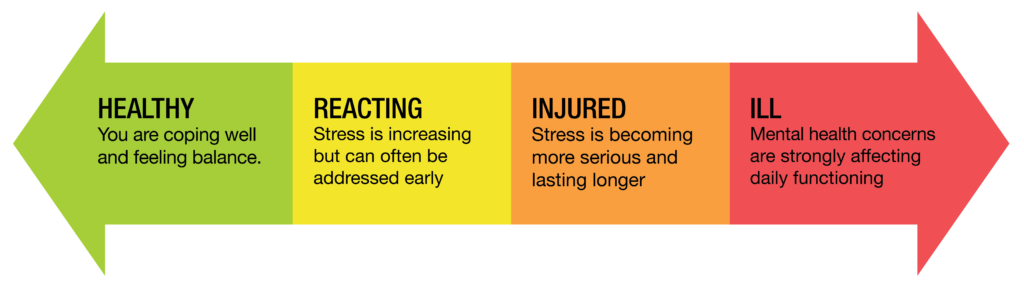
Use the accompanying handout for a visual overview of the four zones, to identify your current zone, and to explore actions and supports that may help maintain or improve your well-being.
Healthy (Green)
Common signs:
- Engaged and focused
- Managing daily demands
- Sleeping and resting well
- Feeling connected to others
- Able to make decisions and function effectively
Actions to take:
- Maintain healthy routines
- Prioritize sleep, movement and nutrition
- Stay connected with supportive people
- Keep boundaries and recovery time between shifts
- Continue regular self-check-ins
Reacting (Yellow)
Common signs:
- Feeling more tired or irritable
- Trouble sleeping sometimes
- Mentally drained after work
- Tasks take more effort
- Harder to relax or switch off
Actions to take:
- Slow down and notice the signs
- Get extra rest and recovery time
- Use coping strategies that work for you
- Check in with a trusted colleague, friend or supervisor
- Reduce or address stressors where possible
Injured (Orange)
Common signs:
- Ongoing exhaustion
- Trouble concentrating
- Feeling disconnected or withdrawn
- Increased negativity or loss of meaning
- Work stress affecting home life
Actions to take:
- Acknowledge that more support may be needed
- Talk with someone you trust
- Seek peer or supervisor support
- Review workload and boundaries
- Consider counselling or professional support early
Ill (Red)
Common signs:
- Engaged and focused
- Managing daily demands
- Sleeping and resting well
- Feeling connected to others
- Able to make decisions and function effectively
Actions to take:
- Maintain healthy routines
- Prioritize sleep, movement and nutrition
- Stay connected with supportive people
- Keep boundaries and recovery time between shifts
- Continue regular self-check-ins
Moving between these zones is normal and human. Noticing where you are early can prevent more serious problems later.
The scenario below shows how someone can move from the healthy zone into the reacting and injured zones. It also shows how they notice these changes and take steps to get support.
Scenario: A caregiver in a healthcare setting begins to notice increased stress during a busy period with ongoing workload and staff shortages.
Reacting (Yellow) > At first, they feel more irritable after shifts and find it harder to relax at home. They replay difficult situations from work and notice they feel more tired and short-tempered than usual, even after days off.
What they do: They notice the change and make small adjustments, such as getting more rest on days off and checking in with a trusted friend or colleague. They remind themselves that this stress is a signal from their mind and body, not a personal failure.
Injured (Orange) > Over time, the stress becomes harder to manage. They feel constantly exhausted and emotionally drained, have less patience with patients and clients, and find it harder to focus at work. They start to withdraw from others and notice that work stress is affecting their personal life.
What they do: They realize their usual coping strategies are no longer enough. They speak privately with a supervisor or wellness contact, use available workplace supports, and consider taking time off or adjusting their workload if possible.
Noticing changes early and reaching out for support can help prevent stress from getting worse and support safer, more sustainable caregiving over time.
Why this matters
Caregivers and healthcare workers often care for other’s safety, comfort, and dignity, sometimes for long hours with little time to recover. Over time, things like staff shortages, heavy workloads, emotional stress, and constant interruptions can build pressure. This makes it harder to rest, focus, and stay connected to meaningful parts of the work.
When people have a shared way to recognize stress early, it becomes easier to support themselves and each other before it turns into burnout or more serious mental health concerns.
What the data shows
Recent research highlights the need for better mental health support:
- Caring in Canada (2024)2: 1 in 4 caregivers report fair or poor mental health. Many feel tired (47%), worried or anxious (44%), or overwhelmed (37%) because of caregiving responsibilities.
- Canadian Medical Association (2025)3: 46% of physicians report high burnout, especially women (49%), and those with 6-20 years of experience.
- Mental Health Research Canada (2025)4: Only 16% of healthcare workers have sought mental health support from 2021 to 2023, even though 26% said they needed it.
This means that many people are dealing with stress, anxiety and burnout without enough support or tools. The Mental Health Continuum can begin to make a real difference. It is not a medical diagnosis or a replacement for professional help. It is a simple, practical tool that helps people understand how they are feeling and take action early.
How to use this in practice
For individuals
- Use the continuum as a personal check-in tool
- Ask yourself:
- “Which zone am I in today?”
- “What is one action I can take before my next shift?”
- Check in regularly, such as weekly or after several shifts
- Reach out early if you notice things getting worse
- For team Use quick check-ins during meetings or shift changes
Simple options:
- Use a “green/yellow/orange/red” prompt
- Show a simple thumbs up/sideways/down
This allows people to signal how they’re doing without sharing details publicly. Follow up privately with anyone who may need support.
In the workplace
- Post the continuum in staff rooms or break areas
- Add prompts like “What zone are you in today?”
- Offer private tools (e.g., a link or QR codes) for self-check-ins and “actions to take.”
- Keep responses anonymous if data is collected.
For leaders
Supervisors and team leads can:
- Learn how to recognize signs of stress
- Have supportive conversations
- Know when to suggest rest, peer support, or professional help
At the organizational level
To make the continuum more than a one-time handout, build it into existing processes (rather than adding extra tasks). For example, include it in:
- Training and onboarding
- Safety discussions
- Wellness programs
Connect it then to broader workplace mental health efforts.
Final thoughts
When people use the same language to talk about mental health, they are more likely to:
- Notice stress early
- Speak up sooner
- Get support before things get worse
The Mental Health Continuum works best when it is paired with clear support options.
- At the individual level, it helps people understand their feelings and take action.
- At the team level, it builds trust and shared understanding
- At the organizational level, it supports a culture where asking for help is a normal and encouraged.
The examples below show simple ways to use of the Mental Health Continuum at the individual, team and organizational levels. For example:
- A unit leader can use the continuum language during huddles to normalize check-ins and spot early signs that someone may need more support.
- A nurse, care aide, physician, or other healthcare worker can recognize when stress is shifting from the reacting to the injured zone and reach out for help earlier.
- Any staff member can use the “actions to take” ideas (e.g. getting enough sleep, setting boundaries, staying connected, debriefing, taking time off, or seeking counselling) as early interventions instead of waiting until they feel overwhelmed or in crisis.
Helpful tools and resources
- Canadian Medical Association: Wellness Hub
- Centre for Addiction and Mental Health (CAMH): Learning Resources
- Caring for Healthcare Workers (MHCC): organizational assessment tools and action resources
- MHCC Catalyst: Care for Health-Care Workers: context and stigma reduction
- Fraser Health Mental Health Continuum Model: a ready-to-share staff-facing tool with suggested action
Crisis support and immediate help
- The resources below can be used if you or someone else needs immediate support:9-8-8 Suicide Crisis Helpline: Call or Text toll-free in Canada for confidential support
- 1-800-SUICIDE: Call 1-800-784-2433 for a confidential crisis line available in British Columbia, 24/7
- 2-1-1: Call or text 2-1-1 to connect with community, government or social services in BC
- KUU-US Crisis Response Service: Call 1-800-588-8717 for culturally safe support for First nations and Indigenous peoples in BC
- Hope for Wellness Helpline: Call 1-855-242-3310. The helpline offers immediate help to all Indigenous people across Canada.
- Mental Health Support Line: Call 310-6789 (no area code needed in B.C.) 24 hours a day for immediate mental health support or referral
- Help Starts Here: Find help for mental health, addiction, anxiety, substance use, and more in British Columbia
References
- Mental Health Commission of Canada, Opening Minds. (n.d.). Mental Health Continuum self-check.
- Canadian Centre for Caregiving Excellence. (2024). Caring in Canada: Survey insights from caregivers and care providers across Canada.
- Canadian Medical Association (2026). CMA 2025 National Physician Health Survey. The Association.
- Mental Health Research Canada. (2025). Mental Health Pulse Check 2025: Insights on the mental health of Canadians as we look ahead in challenging times.