
From Reactivity to Stability:
Practical Steps for Emotional Balance
Emotion regulation is about learning how to manage your feelings so you can stay balanced and respond to daily situations in a positive way. We all experience a wide range of emotions; and these feelings help shape our experiences, reactions, decisions and overall well-being.
The aim of effective emotion regulation is to maintain emotional balance so that our thoughts and feelings do not overwhelm us, disrupt our day-to-day functioning, or prevent us from moving through daily tasks. People consciously and unconsciously use emotion regulation strategies to cope with everyday events, and these strategies help us adapt to different situations. Some strategies are healthy, while others are not, and strategies that once worked well for us may no longer serve us, where they were once effective; they may no longer be.
In this article, we’ll explore what emotion regulation can look like and offer insight and practical tools to better manage emotional response and moments of dysregulation.
Please use the Practical Steps for Emotional Balance handout alongside this article. It includes helpful diagrams and visuals.
This cycle diagram illustrates how a situation can lead to a pattern of responses, including thoughts, emotions, behaviours and bodily reactions.
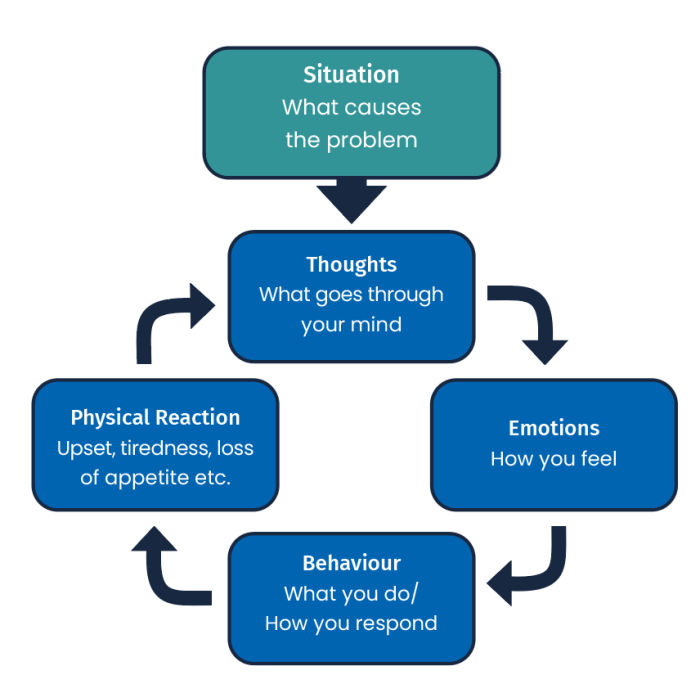
Why do we need to regulate our emotions?
Being able to regulate emotions is important because our emotions are closely connected to how we think and behave. The aim is not to disregard emotions completely, but to recognize and manage them effectively. Our emotions influence how we show up in both our personal and professional lives. Learning skills to regulate our emotions means that instead of acting impulsively, we can make more mindful and intentional choices.
Developing these skills can have many positive effects, such as:
- Have healthier and more manageable relationships with others
- Improve problem-solving skills
- Increase mindfulness and self-awareness
- Enhance self-esteem
- Make more informed decisions
- Become more flexible and adaptable
- Feel more mentally balanced
Recognizing where we are in the cycle
An important part of recognizing our emotions is noticing the patterns of responses and behaviours we move through when faced with a particular scenario. When a scenario triggers a heightened or intense reaction, it can be helpful to ask yourself the following questions:
- Thoughts: What ideas or assumptions came up?
- Emotions: Which feelings are the hardest for me to manage?
- Actions: What can I do before responding?
- Cause: What might be driving this reaction?
- Reflection: Am I satisfied with how I responded?
The questions above allow for a moment of pause and reflection and can be used when you have more time to think things through. These steps can be helpful in addressing an emotional cycle that feels unhelpful or overwhelming.
Practical Steps for Regulating Emotions
By learning how to regulate our emotions, we can better understand ourselves and how we respond to the situations we encounter. These skills can help us manage our feelings more effectively and cope with challenges in healthier ways.
1. Identifying and naming the emotion
When an uncomfortable emotion or feeling arises, try to notice it without judgment. We are often quick to tell ourselves that certain feelings are ‘wrong’ or ‘irrational’ but being able to recognize and label them can reduce self-criticism and make it easier to identify the underlying causes.
Rather than avoiding unpleasant emotions, this step encourages you to acknowledge and name what you are feeling. It can be helpful to think or say the phrase: ‘I am feeling ______.’
You’ll find an emotion word cloud in your handout to support you. It’s common to struggle to find the right word, and this resource can help spark ideas. For this activity, the word cloud highlights emotions commonly associated with challenging emotional experiences, and these words vary in intensity
| Sadness/Loss | Anger/Frustration | Fear/Anxiety | Embarrassment |
|---|---|---|---|
|
|
|
|
| Stress/Pressure | Confusion | Distrust | Isolation |
|---|---|---|---|
|
|
|
|
2. Recognizing the impact of the emotion
To deepen your understanding of the emotion, the steps below outline a way to pay attention to what you are experiencing in your body. Noticing these physical signals can help you to connect them to your emotional awareness.
Pause and notice – Take 15 to 20 seconds of stillness, focus on the emotion you identified from the word cloud, and observe any physical signals that arise.
Examples of physical responses include:
- A tightened chest
- A clenched jaw
- Racing thoughts
- A sense of heaviness
- Restlessness
- Excessive fidgeting
3. Explore your response and validate your feelings
Treating yourself with compassion is an important part for this process. Your emotions are valid, and these feelings typically arise for a reason. It is important to understand that difficult emotions are a natural part of life and can be managed.
- What happened?
- What have I experienced, interpreted, or assumed?
- Why might I feel this way?
4. Connect to emotion to your needs
Difficult emotions often point to potentially unmet needs (e.g., “I am feeling frustrated. I feel like my contributions are not appreciated”). Some common workplace needs include clarity, respect, rest, understanding, safety and connection.
Examples:
- Frustration may indicate a need for clarity, respect, or recognition
- Anxiety may reflect a need for safety or understanding
Please refer to the scenario on the handout for a step-by-step example.
5. Choose a regulating action
Once you’ve identified and understood your emotion and the underlying needs, the next step is to choose actions that help you manage or regulate your response constructively.
Physical
- Take a few slow, deep breaths
- Stretch or move your body intuitively
- Go for a short walk or step away from the situation
Mental
- Write a brief note or journal entry about your emotion
- Talk to a trusted friend, colleague, or mentor
- Reduce distractions or sensory overload to allow for quiet reflection
Social
- Ask for clarifications or feedback (if applicable) in a calm, structured way
- Seek support or perspective from someone neutral
Conclusion
Emotion regulation is a skill that grows with practice. By identifying emotions, understanding their impact, connecting them to needs, and choosing constructive actions, we can respond thoughtfully rather than react impulsively. Over time, these steps foster greater emotional balance, well-being, and resilience in both personal and professional life.
References
- Aldao, A., Nolen-Hoeksema, S., & Schweizer, S. (2010). Emotion-regulation strategies across psychopathology: A meta-analytic review. Clinical psychology review, 30(2), 217-237.
- Mehler, M., Balint, E., Gralla, M., Pößnecker, T., Gast, M., Hölzer, M., Kösters, M., & Gündel, H. (2024). Training emotional competencies at the workplace: a systematic review and metaanalysis. BMC psychology, 12(1), 718. https://doi.org/10.1186/s40359-024-02198-3
Resources